The Environmental Protection Agency’s (EPA) Spill Prevention, Control, and Countermeasure (SPCC) regulation [40 Code of Federal Regulations (CFR) Part 112] requires facilities to develop a plan and implement measures to prevent oil discharges into the waters of the United States.
However, the regulation does not provide enough detail in its definition of “oil” to help facilities clearly determine which materials are covered. Common substances like fuel oils, vegetable oils, diesel, and gasoline are generally understood to fall under the SPCC regulation. But the status of other materials—such as certain pesticides, paints, and solvents—is less clear.
To address this gap, I’ve spent years working to better understand the regulatory definition of oil. As a result, I developed a flowchart that can help you assess whether your materials may be considered oils under the SPCC regulation.
28.2.1 Flowchart for Identifying Oils
28.2.1.1 Flowchart Development
Based on the information presented on the following pages, I developed a flowchart to help determine whether a material is classified as an oil or not an oil (e.g., a hazardous substance). This flowchart is largely based on flowcharts originally published in two articles from the “Proceedings of Joint Conference on Prevention and Control of Oil Spills”: June 15–17, 1971. Sheraton Park Hotel, Washington, D.C.:
- “Oil Versus Other Hazards Substances” by C. Hugh Thompson, Water Quality Office, Environmental Protection Agency
- “Properties and Effects of Nonpetroleum Oils” by Hans J. Crump-Wiesner and Allen L. Jennings, Environmental Protection Agency
However, I have added several parameters to make the determination process more practical and easier to apply—without changing the intent of the original version.
One key addition is the first question: “Is the material listed as a Hazardous Substance in 40 CFR 302.4(a)?” If it is, then the material is classified as a hazardous substance and is not considered an oil under the SPCC regulation. Although many of these substances would likely be ruled out later in the process, placing this question first provides a straightforward, unambiguous starting point—helping to eliminate uncertainty early on.
Since the original flowchart was created, the EPA has made further clarifications, including exempting milk and milk products from SPCC requirements, even though they are still technically considered oils. This reflects how regulatory interpretation can evolve.
Recognizing that some materials—such as oily water generated from on-site operations—are mixtures without a single Safety Data Sheet (SDS), I added a set of questions addressing a material’s ingredients. For example, if the mixture contains oil and still exhibits oil-like properties, it may be subject to SPCC requirements. This also covers materials that are blends of oils and non-oils.
While this revised flowchart provides clearer guidance, some questions – such as “Will the material violate applicable water quality standards?” or “Is the material extractable with an organic solvent?”—may not have definitive answers. In such cases, the conservative approach is to move up the flowchart (i.e., toward the top of the page), favoring a more protective interpretation.
28.2.1.2 Flowchart for Identifying Oils Under the SPCC Regulation
Figure 28.2.1.2-1 is the Flowchart for Identifying Oils Under the SPCC Regulation.
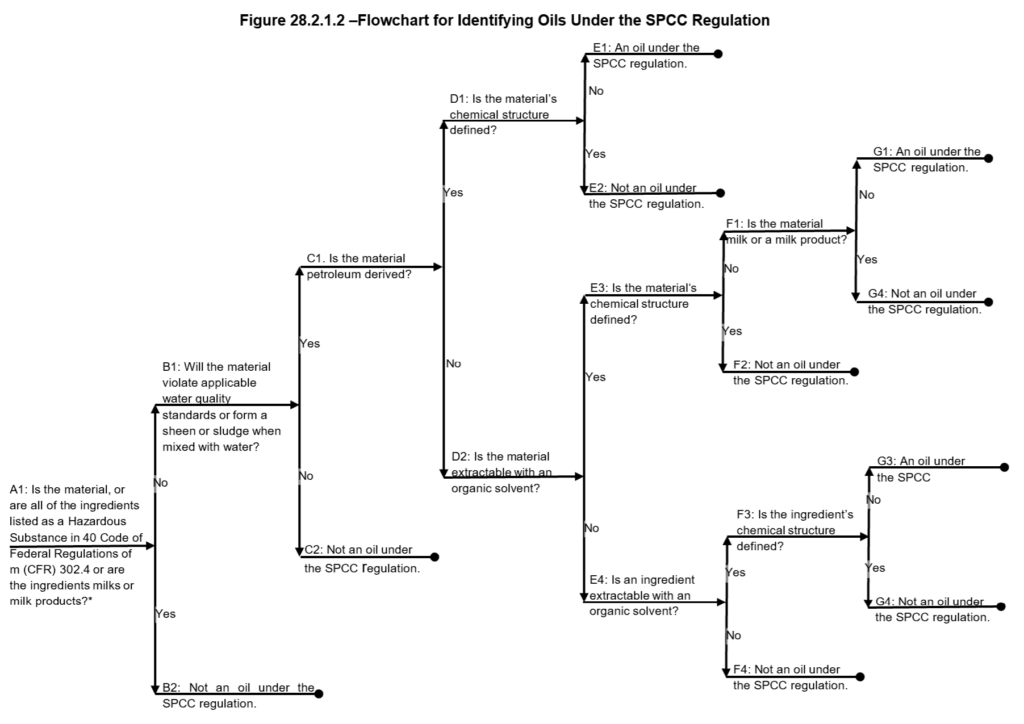
28.2.2 Definitions for Use with the Flowchart for Identifying Oils Under the SPCC Regulation
The following definitions are intended to support the application of the flowchart used to determine whether a material qualifies as an oil under the EPA’s Spill Prevention, Control, and Countermeasure (SPCC) regulation.
40 CFR 302.4
This section of the EPA’s regulations lists hazardous substances under the Comprehensive Environmental Response, Compensation, and Liability Act (CERCLA)[1].
Note: If all of a material’s ingredients are listed in 40 CFR 302.4 but the ingredients form a homologous series, the hazardous substance exemption does not apply.
Chemical Structure Defined
A material has a defined chemical structure when the arrangement of atoms and functional groups is known[2]. For example:
- Toluene has a well-defined molecular structure.
- Gasoline, a mixture of many compounds, does not have a single defined structure—even if the structure of its individual components is known.
Some compounds are isomers, meaning they have the same chemical formula but different molecular structures. Isomers themselves are not considered oils[3]. However, a homologous series of isomers—where each successive compound differs by one methyl group—is considered to be an oil[4].
Extractable with an Organic Solvent
There is no specific test method defined by EPA for determining whether a material is extractable with an organic solvent. The 1971 Proceedings of the Joint Conference on Prevention and Control of Oil Spills reference solvents such as benzene, carbon tetrachloride, and chloroform for extraction[5].
As a conservative approach, assume that any material containing organic compounds is extractable with an organic solvent. Even water-soluble organic materials may exhibit partial extraction under certain conditions.
Hazardous Substance
A hazardous substance is any material listed in 40 CFR 302.4[6].
Highly Volatile Materials
Highly volatile liquids evaporate quickly under normal environmental conditions and generally do not form a sheen or sludge when released into water. As a result, they typically do not violate applicable water quality standards[7]. For example, propane is highly volatile and will evaporate upon release, leaving no sheen or sludge behind.
Ingredient
An ingredient is a material intentionally and specifically added to a product or mixture. If a paint manufacturer directly adds toluene, then toluene is an ingredient. If the manufacturer adds mineral spirits (which contains toluene, but is a mixture of a number of various substances), the ingredient is mineral spirits – not toluene itself. In this case, the oil classification of mineral spirits governs the evaluation.
Milk and Milk Products
Although the EPA does not explicitly define “milk and milk products,” these materials are considered oils under the SPCC regulation[8]. However, they are exempt from SPCC requirements if:
- The storage and handling systems comply with 3-A Sanitary Standards, and
- The systems are regulated under the Grade “A” Pasteurized Milk Ordinance (PMO) or an equivalent state dairy regulation[9].
This exemption was formalized under the SPCC Rule Amendments for Milk and Milk Product Containers, effective June 17, 2011.
Oil
The term “oil” includes oil in any kind or form, such as:
- Fats, oils, or greases of animal, fish, or marine origin
- Oils derived from seeds, nuts, fruits, or kernels
- Petroleum products, fuel oil, sludge, synthetic oils, mineral oils, oil refuse, or oil mixed with wastes (excluding dredged spoil)[10]
Violation of Applicable Water Quality Standards or Formation of a Sheen or Sludge
A material that is volatile (e.g., listed as a gas at atmospheric pressure on the Safety Data Sheet) and evaporates completely under ambient conditions is not expected to form a sheen or sludge[11].
Violations of water quality standards may include, but are not limited to:
- A sheen, which is a thin oil film floating on the water surface.
- A sludge, which is a heavier, separate phase that settles to the bottom[12].
Other examples of water quality standards that might be violated include:
- Exceeding National Pollutant Discharge Elimination System (NPDES) permit limits
- Exceeding Total Maximum Daily Load (TMDL) thresholds.
Water-Soluble Materials
Water-soluble materials are miscible with water and therefore do not form a separate sheen or sludge. This property is typically indicated in the material’s Safety Data Sheet (SDS).
However, even though they dissolve completely in water, water-soluble materials can still violate water quality standards if released in sufficient concentrations.
28.2.3 Definition of Oil
The original definition of oil from the Federal Water Pollution Control Act (FWPCA) (i.e., the act that resulted in the original Spill Prevention Control and Countermeasures (SPCC) regulation) is:
“Oil means oil of any kind or in any form, including, but not limited to, petroleum, fuel oil, sludge, oil refuse, and oil mixed with wastes other than dredged spoil;”[13]
The current definition of oil in the Clean Water Act is:
“(23) “oil” means oil of any kind or in any form, including petroleum, fuel oil, sludge, oil refuse, and oil mixed with wastes other than dredged spoil, but does not include any substance which is specifically listed or designated as a hazardous substance under subparagraphs (A) through (F) of section 101(14) of the Comprehensive Environmental Response, Compensation, and Liability Act (42 U.S.C. 9601) and which is subject to the provisions of that Act [42 U.S.C. 9601 et seq.]“[14]
The definitions of oil in the Spill Prevention Control and Countermeasures (SPCC) regulation include:
“Oil means oil of any kind or in any form, including, but not limited to: fats, oils, or greases of animal, fish, or marine mammal origin; vegetable oils, including oils from seeds, nuts, fruits, or kernels; and, other oils and greases, including petroleum, fuel oil, sludge, synthetic oils, mineral oils, oil refuse, or oil mixed with wastes other than dredged spoil.”
“Non-petroleum oil means oil of any kind that is not petroleum-based, including but not limited to: Fats, oils, and greases of animal, fish, or marine mammal origin; and vegetable oils, including oils from seeds, nuts, fruits, and kernels.”
“Petroleum oil means petroleum in any form, including but not limited to crude oil, fuel oil, mineral oil, sludge, oil refuse, and refined products.”
“Vegetable oil means a non-petroleum oil or fat of vegetable origin, including but not limited to oils and fats derived from plant seeds, nuts, fruits, and kernels.”[15]
28.2.4 Original Flowchart
Other than the Environmental Protection Agency (EPA) regulations and Federal Register pre-ambles and a few older guidance documents, I have not identified specific Environmental Protection Agency (EPA) guidance on the definition of oil with the exception of the two articles identified earlier from the “Proceedings of the Joint Conference on Prevention and Control of Oil Spills” (hereinafter referred to as the “Proceedings”). I used this information and newer information to develop a flowchart for identifying materials as oils under the Spill Prevention Control and Countermeasures (SPCC) regulation. Although I have encountered informal agreement with the flowchart concepts from Environmental Protection Agency (EPA) personnel, I cannot guarantee that each Environmental Protection Agency (EPA) Region and employee will agree with the flowchart. However, in the absence of guidance from the Environmental Protection Agency (EPA), I developed this chart to serve as appropriate inquiry.
As part of the flowchart development, I considered the material information available to a facility to make an oil determination. Typically, a facility will rely on safety data sheets (SDSs) for material information (e.g., physical data and ingredient lists). In the absence of a material safety data sheet (SDS) or insufficient safety data sheet (SDS) data to make the determination, a facility may have to contact the manufacturer or send a sample to a laboratory for analysis. Therefore, to simplify the oil determination process, I designed the flowchart to utilize information that may be identified on a safety data sheet (SDS) first.
28.2.5 Review of Available Information
I have reviewed available information on various interpretations of the term “oil” as it relates to the SPCC regulation and Clean Water Act-related information. The following sections detail the review of available information.
28.2.5.1 Oil Pollution Act of 1961
28.2.5.1.1 Overview
The Environmental Protection Agency (EPA) has provided the interpretation that mixtures of oils and other materials are considered oils under the SPCC regulation[16]. This interpretation is based on the contention that a small amount of oil, mixed with other materials, can still form a sheen or sludge and has been provided as far back as the Oil Pollution Act (OPA) of 1961, which states:
“…oil in an oily mixture of less than one hundred parts of oil in one million parts mixture, shall not be deemed to foul the surface of the sea.”[17]
It is assumed that a mixture with oil at one hundred parts per million or greater would be considered an oil by this definition (i.e., would form a sheen and foul the surface of the sea), however, the regulatory applicability of this definition to the Spill Prevention Control and Countermeasures (SPCC) regulation is unclear. Additionally, the solubility of oils varies, and higher or lower concentrations of oils may or may not create or sheen or sludge in water (i.e., the one part per million concentration is not a definitive cutoff).
28.2.5.1.2 Summary
Based on the definition of a harmful discharge, you can assume that if an oil is mixed with a non-oil, it will still form a sheen or sludge in water and the mixture would still be considered an oil. Also, if the mixture of an oil in a non-oil is still concentrated enough to violate an applicable water quality standard, the mixture would still be considered an oil.
28.2.5.1.3 Examples
An example of an oil mixed with non-oils is oily wastewater. Oily wastewater is encountered in industrial operations where water and oil mix. The oily wastewater is often segregated (e.g., collected in a tank) and treated. If the oily wastewater has enough oil that a separate phase is present (i.e., a sheen or sludge), the oily wastewater would be considered an oil.
Another example is ethanol (i.e., a mixture of ethanol and water) that has gasoline added as a denaturant. Ethanol is not an oil, is water soluble, and will not form a sheen in water. Gasoline is an oil, is not water soluble, and will form a sheen in water. The ethanol acts to dissolve the gasoline and the mixture of ethanol, water and gasoline does not have a separate phase. Although under normal conditions a spill of denatured ethanol into water would not be expected to form a separate phase, the Environmental Protection Agency (EPA) noted in a November 6, 2006 letter from Susan Parker Bodine, an Assistant Administrator of the Environmental Protection Agency (EPA) to Mr. Bob Dinneen, the President and CEO of the Renewable Fuels Association that in some conditions, such as cold water, the gasoline could separate out and form a sheen[18].
28.2.5.2 Federal Water Pollution Control Act and Clean Water Act
28.2.5.2.1 Overview
The Federal Water Pollution Control Act (FWPCA) and subsequent Clean Water Act (CWA) amendments to the FWPCA differentiate between oils and hazardous substances. The FWPCA is the act that resulted in the Environmental Protection Agency’s (EPA) Spill Prevention Control and Countermeasures (SPCC) regulation [40 Code of Federal Regulations (CFR) 112] which addresses oils, but not hazardous substances.
The current version of the CWA [Title 33, Chapter 40, Subchapter I, 2701] excludes hazardous substances under subparagraphs (A) through (F) of section 101(14) of the Comprehensive Environmental Response, Compensation, and Liability Act (CERCLA) [42 U.S.C. 9601].
Title 42, Chapter 103, Subchapter I, Section 9601 part 14 has the following definition of a hazardous substance:
“The term ‘hazardous substance’ means:
- any substance designated pursuant to section 1321(b)(2)(A) of title 33,
- any element, compound, mixture, solution, or substance designated pursuant to section 9602 of this title,
- any hazardous waste having the characteristics identified under or listed pursuant to section 3001 of the Solid Waste Disposal Act [42 U.S.C. 6921] (but not including any waste the regulation of which under the Solid Waste Disposal Act [42 U.S.C. 6901 et seq.] has been suspended by Act of Congress),
- any toxic pollutant listed under section 1317(a) of title 33,
- any hazardous air pollutant listed under section 112 of the Clean Air Act [42 U.S.C. 7412], and
- any imminently hazardous chemical substance or mixture with respect to which the Administrator has taken action pursuant to section 2606 of title 15.
The term does not include petroleum, including crude oil or any fraction thereof, which is not otherwise specifically listed or designated as a hazardous substance under subparagraphs (A) through (F) of this paragraph, and the term does not include natural gas, natural gas liquids, liquefied natural gas, or synthetic gas usable for fuel (or mixtures of natural gas and such synthetic gas).”[19]
28.2.5.2.2 Summary
If a material is listed as a hazardous substance, than the material is not an oil. However, a mixture of a hazardous substance and an oil may be an oil (i.e., and also a hazardous substance). The following sections provide additional information on the hazardous substance references identified above:
(A) Title 33, Chapter 40, Subchapter I, Section 1321
Title 33, Chapter 40, Subchapter I, Section 1321 established the Designation of Hazardous Substances in 40 Code of Federal Regulations (CFR) 116[20].
(B) Title 42, Chapter 103, Subchapter I, Section 9602
Title 42, Chapter 103, Subchapter I, Section 9602 established the CERCLA List of Hazardous Substances and Reportable Quantities in 40 Code of Federal Regulations (CFR) 302. I have included the materials identified in 40 Code of Federal Regulations (CFR) 302 on the list in Appendix B[21].
(C) Title 42, Chapter 82, Subchapter III, Section 6921
Title 42, Chapter 82, Subchapter III, Section 6921 established the definition of a hazardous waste under the Resource Conservation Recovery Act (RCRA) in 40 Code of Federal Regulations (CFR) 261.3 Definition of hazardous waste[22].
(D) Title 33, Chapter 26, Subchapter III Section 1317
Title 33, Chapter 26, Subchapter III Section 1317 established toxic and pretreatment effluent standards for the National Pollutant Discharge Elimination System (40 Code of Federal Regulations (CFR) Subchapter N)[23].
(E) Title 42, Chapter 85, Subchapter I, Part A, Section 7412
Title 42, Chapter 85, Subchapter I, Part A, Section 7412 established the list of Hazardous Air Pollutants (HAPs) under the Clean Air Act (40 Code of Federal Regulations (CFR) 61.01). The list of HAPs is included on the list included in Appendix B[24].
(F) Title 15, Chapter 53, Subchapter I, Section 2606[25]
Title 15, Chapter 53, Subchapter I, Section 2606 established the Toxic Substance Control Act, which allows the Environmental Protection Agency (EPA) to commence civil action related to an imminently hazardous chemical substance or mixture.
28.2.5.2.3 Example
Xylene is an example of a material that may have oil-characteristics or physical properties (e.g., it is not soluble in water and will form a sheen when mixed with water). However, xylene is on the list of hazardous substances included in Appendix B. Therefore, xylene is not considered an oil.
28.2.5.3 Proceedings of the Joint Conference on Prevention and Control of Oil Spills
28.2.5.3.1 Overview
The “Proceedings of the Joint Conference on Prevention and Control of Oil Spills” (hereinafter referred to as the “Proceedings”) on June 15 to 17, 1971, in Washington, D.C resulted in two documents:
- “Oil Versus Hazardous Substances” by C. Hugh Thompson, of the Water Quality Office of the EPA, and
- “Properties and Effects of Nonpetroleum Oils” by Hans J. Crump-Wiesner and Allen L. Jennings, Environmental Protection Agency
In “Oil Versus Hazardous Substances”, Mr. Thompson explains that oils are complex mixtures that are defined by their physical properties (e.g., boiling point, melting point, density, viscosity, etc.) and not the chemical structure[26]. Included in the “Oil Versus Hazardous Substances” is a flowchart for distinguishing between oils and hazardous substances which is replicated as Figure 28.2.5.3.1-1:
Figure 28.2.5.3.1–1 Rationale for Distinguishing Between Oils and Materials that may be Hazardous Substances from the “Proceedings of the Joint Conference on Prevention and Control of Oil Spills”[27]
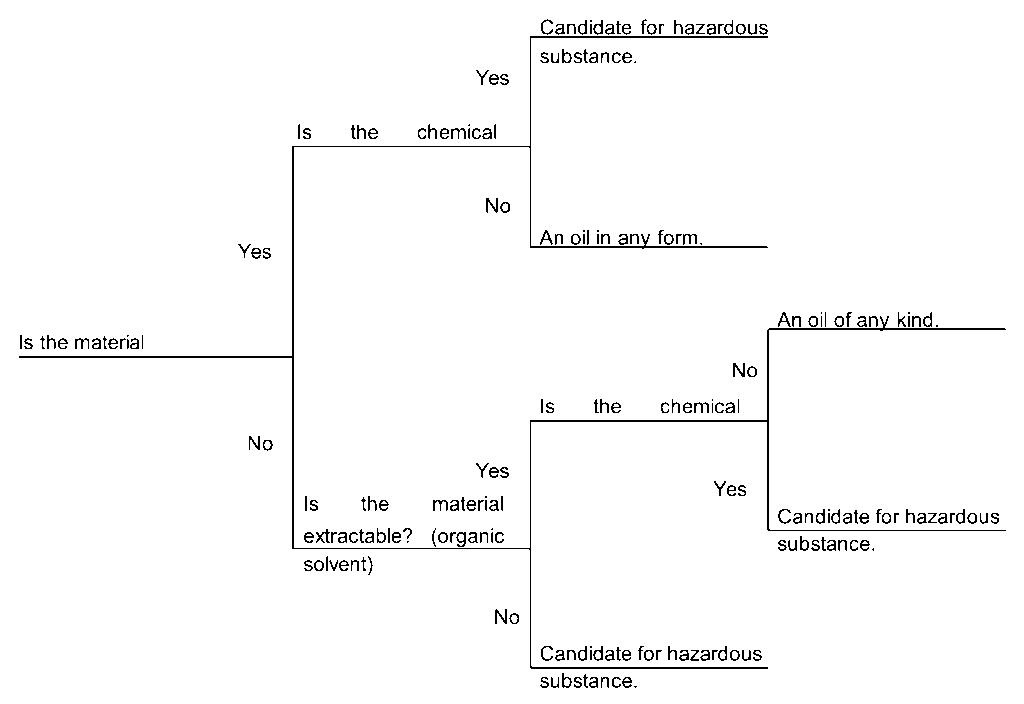
In “Properties and Effects of Nonpetroleum Oils”, the authors note that petroleum and non-petroleum oils have the following characteristics:
- Limited water solubility
- Solubility in organic solvents
- Causes surface slicks, emulsions and sludges[28]
28.2.5.3.2 Summary
Based on the flowchart and the text of the “Proceedings”, the following conclusions can be drawn:
- Oils are assumed to be extractable with an organic solvent or contain materials that are extractable with an organic solvent, and
- Oils do not have a defined chemical structure.
The “Proceedings” do not provide a specific extraction procedure or a quantifiable amount of material that needs to be extracted to meet the definition of “extractable with an organic solvent”. The “Proceedings” also do not provide a definition of “defined chemical structure.”
28.2.5.4 Harmful Discharge of Oil
28.2.5.4.1 Overview
As part of the determination of the SPCC applicability to a facility, the facility must be reasonably expected to discharge oil in harmful quantities[29]. The SPCC regulation refers to the definition of a “harmful discharge of oil” as defined in 40 Code of Federal Regulations (CFR) 110.3[30]:
“For purposes of section 311(b)(4) of the Act, discharges of oil in such quantities that the Administrator has determined may be harmful to the public health or welfare or the environment of the United States include discharges of oil that:
(a) Violate applicable water quality standards; or
(b) Cause a film or sheen upon or discoloration of the surface of the water or adjoining shorelines or cause a sludge or emulsion to be deposited beneath the surface of the water or upon adjoining shorelines.”[31]
Based on this definition, if a material forms a sheen or sludge in water, it may be an oil. Sheen and sludge are defined in 40 Code of Federal Regulations (CFR) 110.1:
- “Sheen means an iridescent appearance on the surface of water”
- “Sludge means an aggregate of oil or oil and other matter of any kind in any form other than dredged spoil having a combined specific gravity equivalent to or greater than water”[32]
28.2.5.4.2 Summary
Based on this definition, an oil is assumed to be immiscible (i.e., insoluble) in water (i.e., the oil forms a separate and distinct phase when added to water). However, because the definition of “harmful discharge of oil” also includes violating applicable water quality standards, the formation of a sheen or sludge may not be a definitive property of an oil (e.g., a water soluble material can violate applicable water quality standards by changing the pH, exhibiting biochemical oxygen demand, causing turbidity, etc.). Therefore, the fact that the material does not form a sheen or sludge, does not preclude the material from the definition of an oil.
Some materials will not form a sheen and sludge and will not violate applicable water quality standards because of their volatility (e.g., natural gas). These materials are not considered oils even if they exhibit other properties of oils.
28.2.5.5 Guidance on Clean Water Act Definition of Oil
28.2.5.5.1 Overview
From my time as an Environmental Protection Agency (EPA) contractor, I have an unofficial document (i.e., no source is provided) titled: “Guidance on Clean Water Act Definition of Oil“ dated September 16, 1993. This document provides a list of several oils and non-oils and conditions for determining if a material is an oil or non-oil:
- Isomers (i.e., materials that have identical formulas, but different molecular arrangements) are not oils.
- A mixture of a homologous series of isomers (i.e., a series of compounds where each successive member has one more methyl group than the preceding member) is an oil.
- A non-petroleum derived material that is extractable by an organic solvent qualifies is an oil if its chemical structure is not defined or it is a complex mixture of chemical compounds.
An example of a material that is an isomer is xylene. Unless otherwise noted, xylene is normally a mixture of three isomers:
- ortho-Xylene (1,2-dimethylbenzene),
- meta-Xylene (1,3-dimethylbenzene), and
- para-Xylene (1,4-dimethylbenzene).
Each of these isomers has the same chemical formula (i.e., C8H10), but their chemical structures are different as illustrated in Figure 28.2.5.5.1-1.
Figure 28.2.5.1.1–1 Varying Structures of Xylene Isomers
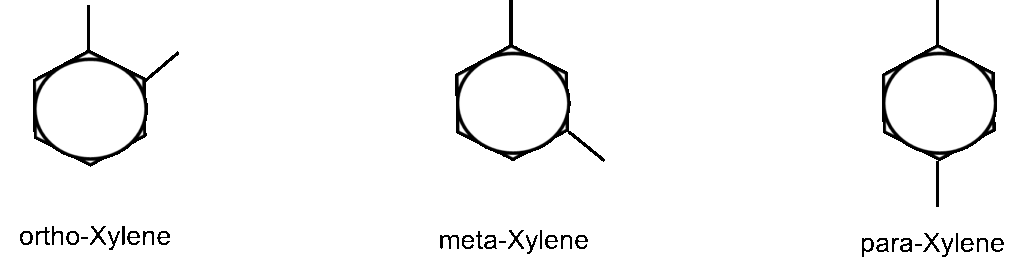
Xylene would not be considered an oil based on this guidance document.
An example of a homologous series of isomers is a mixture of benzene, toluene and xylene. Toluene has one more methyl group than benzene, and xylene has one more methyl group than toluene as illustrated in Figure 28.2.5.5.1-2.
Figure 28.2.5.1.1-2– Homologous Series of Isomers
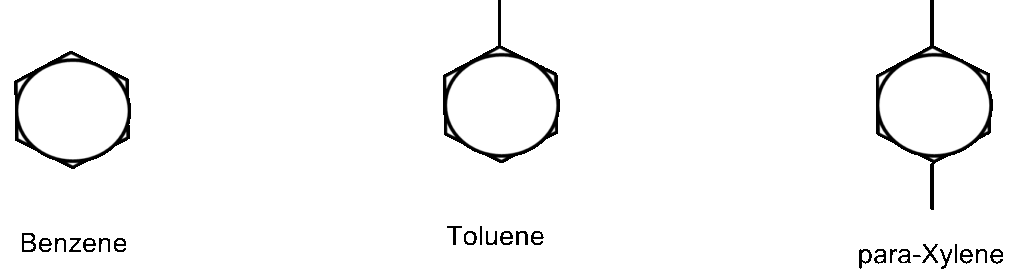
A mixture of benzene, toluene and xylene would be considered an oil based on this guidance.
28.2.5.5.2 Summary
This document references, and is in general agreement with the “Proceedings of the Joint Conference on Prevention and Control of Oil Spills” document. However, this document provides more details on the interpretation of a “defined chemical structure” differentiating between isomers and homologous series.
28.2.5.6 Denial of Petition, October 20, 1997
28.2.5.6.1 Overview
In the October 20, 1997 Federal Register (“Denial of petition requesting amendment of the Facility Response Plan rule”, Volume 62, Number 202, pages 54508 to 54543), the Environmental Protection Agency (EPA) denied a request submitted by various trade associations to amend the Facility Response Plan (FRP) rule[33]. On Table 2 in Appendix I of this Federal Register document, the Environmental Protection Agency (EPA) provided a comparison of vegetable oils and animal fats with petroleum oils[34]. The physical properties of various oils are addressed on this table and the common physical properties for the oils include:
- Most are insoluble in water and soluble in organic solvents, and
- Most float on water and some sink[35].
On Table 1 in Appendix I, the Environmental Protection Agency (EPA) provides a comparison of physical properties of vegetable oils and animal fats with petroleum oils[36]. One commonality with the oils is they are insoluble in water.
22.1.1.2.2 Summary
The October 20, 1997 Federal Register denial of petition identified lists of materials that are considered oils and provided details on various properties of oils. One common physical property is that oils are insoluble in water. Conversely, this physical property could be construed to say that if a material is soluble in water, it is not an oil. Although this physical property agrees with previous information in this chapter, the previous sections also imply that this physical property is not the sole descriptor for determining if a material is an oil.
28.2.5.7 Federal Register Volume 67, Number 137 July 17, 2002
28.2.5.7.1 Overview
On July 17, 2002, the Environmental Protection Agency (EPA) revised the SPCC regulation. Included within this revision are comments on the definition of oil:
“Background. In 1991, Environmental Protection Agency (EPA) reprinted the definition of oil without suggesting any changes. In response to Edible Oil Regulatory Reform Act (EORRA) of 1995 (33 U.S.C. 2720) requirements, we have reworded the definition to include the categories of oil included in EORRA. Those categories are: (1) petroleum oils, (2) animal fats and vegetable oils; and, (3) other non-petroleum oils and greases. Animal fats include fats, oils, and greases of animal origin (for example, lard and tallow), fish (for example, cod liver oil), or marine mammal origin (for example, whale oil). Vegetable oils include oils of vegetable origin, including oils from seeds, nuts, fruits, and kernels. Examples of vegetable oils include: corn oil, rapeseed oil, coconut oil, palm oil, soy bean oil, sunflower seed oil, cottonseed oil, and peanut oil. Other non-petroleum oils and greases include coal tar, creosote, silicon fluids, pine oil, turpentine, and tall oils. Petroleum oils include crude and refined petroleum products, asphalt, gasoline, fuel oils, mineral oils, naphtha, sludge, oil refuse, and oil mixed with wastes other than dredged spoil.
EORRA requires that Federal agencies establish separate classes for at least these three types of oils. It further requires agencies to differentiate between those classes of oil in relation to their environmental effects, and their physical, chemical, biological, and other characteristics. Environmental Protection Agency (EPA) has provided new subparts within part 112 to facilitate differentiation between the categories of oil listed in EORRA. In an advance notice of proposed rulemaking, published on April 8, 1999 (64 FR 17227), we requested ideas on how to differentiate among the SPCC requirements for facilities storing or using the various categories of oil. These ideas for further differentiation will be considered in a future rulemaking.
Today’s amendments to the definition and the creation of subparts have no effect on information collection, because we already include all types of oil in our information collection burden calculations. Similarly, the definition imposes no new requirements, because all oils have always been subject to the substantive requirements of the rule.
Comments. What is oil. Several commenters favored the proposed 1991 definition, which is identical to the current definition. Some asked for clarification as to its scope, particularly in reference to animal and vegetable oils, synthetic oils, mineral oils, and petroleum derivatives.
Specific substances. Others asked about specific substances like aromatic hydrocarbons and asphaltic cement. One commenter asked if bilge water is oil.
Authority. Some commenters suggested that Environmental Protection Agency’s (EPA) authority did not extend beyond petroleum-based oils.
Exclusions. Some commenters sought exclusions from the definition, generally based on contentions that certain oils (such as vegetable oils) are not harmful to the environment if discharged. One commenter suggested a definition based on the liquidity of oil, founded on a rationale that solid or gaseous oils do not pose a threat to waters of the United States when discharged at a fixed facility. Another commenter urged that we exempt refined petroleum products from the definition because releases from many of these products are regulated by other statutes, such as the Solid Waste Disposal Act. One State commenter noted that animal and vegetable oils are not subject to regulation under that State’s statutes regulating oil.
Oil mixed with wastes or hazardous substances. Others asked for clarification as to whether mixed substances, used oil, and waste oils were oil.
Part 280 definition. One commenter noted the difference in definitions between the part 112 definition and the definition in 40 Code of Federal Regulations (CFR) part 280. Response to comments. What is oil. Environmental Protection Agency (EPA) interprets the definition of oil to include all types of oil, in whatever form, solid or liquid. That includes synthetic oils, mineral oils, vegetable oils, animal fats, petroleum derivatives, etc.
Specific substances. As to certain specific substances, asphaltic cement is oil because it is a petroleum-based product and exhibits oil-like characteristics. A discharge of asphaltic cement may violate applicable water quality standards, or cause a film or sheen or discoloration of the water or adjoining shorelines or cause a sludge or emulsion to be deposited beneath the surface of the water or upon adjoining shorelines. Aromatic hydrocarbons may or may not be oil, depending on their physical characteristics and environmental effects. Some aromatic hydrocarbons are hazardous substances. Bilge water that contains sufficient oil such that its discharge would violate the standards set out in 40 Code of Federal Regulations (CFR) 110.3 is considered oil. The percentage of oil concentration in the water is not determinative for the purpose of the definition or the discharge standards.
Authority. We disagree that our authority only extends to petroleum-based oils. Our interpretation is consistent with Congressional intent as expressed in section 311(a)(1) of the CWA, which extends to all types of oils in any form. Environmental Protection Agency’s (EPA) definition tracks that statutory definition. Our revised definition also reflects EORRA requirements for differentiation. EORRA did not expand or contract the universe of substances that are oils, it only required differentiation, when necessary, between the requirements for facilities storing or using different types of oil.
Exclusions. While States may choose to regulate all oils or some oils, the CWA definition is designed to prevent the discharge of all oils. A definition based on liquidity would exclude solid oils, such as certain animal fats, a result that would be inconsistent with Congressional intent. Concerning gaseous oils, see our discussion on Highly volatile liquids below. While releases or discharges of some refined petroleum products may be regulated under the Solid Waste Disposal Act as waste products, that program is dedicated more to waste management, and does not regulate storage of non-waste oil.
All oils, including animal fats and vegetable oils, can harm the environment in many ways. Oil can coat the feathers of birds, the fur of mammals and cause drowning and hypothermia and increased vulnerability to starvation and predators from lack of mobility. Oils can act on the epithelial tissue of fish, accumulate on gills, and prevent respiration. The oil coating of surface waters can interfere with natural processes, oxygen diffusion/reaeration and photosynthesis. Organisms and algae coated with oil may settle to the bottom with suspended solids along with other oily substances that can destroy benthic organisms and interfere with spawning areas. Oils can increase biological or chemical oxygen demand and deplete the water of oxygen sufficiently to kill fish and other aquatic organisms. Oils can cause starvation of fish and wildlife by coating food and depleting the food supply. Animals that ingest large amounts of oil through contaminated food or preening themselves may die as a result of the ingested oil. Animals can also starve because of increased energy demands needed to maintain body temperature when they are coated with oil. Oils can exert a direct toxic action on fish, wildlife, or their food supply. Oils can taint the flavor of fish for human consumption and cause intestinal lesions in fish from laxative properties. Tainted flavor of fish used for human consumption and the causation of rancid odors are public health or welfare concerns within the scope of our rules. Tainted flavor of fish used for human consumption may indicate a disease in the fish which could render them inedible and thus have a substantial impact on the fishermen who harvest them and communities who may rely on them for a food supply. Oils can foul shorelines and beaches. Oil discharges can create rancid odors. Rancid odors may cause both health impacts and environmental impacts. For example, the 1991 Wisconsin Butter Fire and Spill resulted in a discharge of melted butter and lard. After the cleanup was largely completed, the Wisconsin Department of Natural Resources declared as hazardous substances the thousands of gallons of melted butter that ran offsite and the mountain of damaged and charred meat products spoiling in the hot sun and creating objectionable odors. The Wisconsin DNR stated that these products posed an imminent threat to human health and the environment. 62 FR 54526.
Highly volatile liquids. We do not consider highly volatile liquids that volatilize on contact with air or water, such as liquid natural gas, or liquid petroleum gas, to be oil. Such substances do not violate applicable water quality standards, do not cause a reportable film or sheen or discoloration upon the surface of water or adjoining shorelines, do not cause a sludge or emulsion to be deposited beneath the surface of the water or upon adjoining shorelines, and are not removable. Therefore, there would be no reportable discharge as described in 40 Code of Federal Regulations (CFR) 110.3.
Oil mixed with wastes or hazardous substances. Oil means oil of any kind or in any form, including, but not limited to: fats, oils, or greases of animal, fish, or marine mammal origin; vegetable oils, including oils from seeds, nuts, fruits, or kernels; and, other oils and greases, including petroleum, fuel oil, sludge, synthetic oils, mineral oils, oil refuse, or oil mixed with wastes other than dredged spoil.
Part 280 definition. The definition of petroleum in 40 Code of Federal Regulations (CFR) part 280 is a subset of the part 112 definition of ‘‘oil.’’ The part 112 definition of oil is broader than the part 280 definition of petroleum because part 112 regulates all types of oils, whereas part 280 regulates only petroleum.”[37]
28.2.5.7.2 Summary
A summary of pertinent information from the preamble to the July 17, 2002 revised SPCC regulation includes:
- Oils are not limited to petroleum products but include oils derived from animals and vegetables,
- Materials that are gases under atmospheric conditions are not oils,
- Mixtures of oils and non-oils may still be considered oils,
- A material is an oil if it exhibits an oil-like characteristic, and
- An oil is defined by its physical characteristics and environmental effect.
The preamble to the July 17, 2002 does not provide further information on what an “oil-like characteristic” is and does not identify what physical characteristics and environmental effects define an oil.
28.2.5.8 Renewable Fuels Association Letter
28.2.5.8.1 Overview
I reviewed of the November 6, 2006 letter from Susan Parker Bodine, an Assistant Administrator of the Environmental Protection Agency (EPA) to Mr. Bob Dinneen, the President and CEO of the Renewable Fuels Association that discusses the definition of an oil under the FRP regulation [40 Code of Federal Regulations (CFR) 112.20 and 21]. In the letter, the Environmental Protection Agency (EPA) declares that ethanol, which is not considered an oil, denatured with gasoline, which is considered an oil, is an oil under the FRP regulation because of the regulations do not identify a de minimis oil concentration[38]. The Environmental Protection Agency (EPA) also identifies a criteria that they use to identify an oil : the potential for a material to phase separate when discharged into water[39].
28.2.5.8.2 Summary
A summary of pertinent information from the letter to the Renewable Fuels Association includes:
- A physical characteristic of an oil is its insolubility in water.
- A chemically defined and water soluble material, such as ethanol, is not considered an oil.
- Mixtures of oils and non-oils may be oils if the oil concentration is high enough so that the resulting mixture still exhibits the characteristics of an oil.
28.2.5.9 United States Coast Guard
28.2.5.9.2 Summary
During discussions with Environmental Protection Agency (EPA) personnel, I have been referred to the U.S. Coast Guard’s website for determination of whether a material is an oil. The U.S. Coast Guard maintains a list of petroleum and non-petroleum oils on their web-site at the following address:
List of Petroleum and Non-petroleum Oils[8].
I spoke with Tom Felleisen of the U.S. Coast Guard regarding the petroleum and non-petroleum oils list. Mr. Felleisen stated that the U.S. Coast Guard’s list is based on materials that are transported in tankers (i.e., if the material is not commonly transported in tankers, then the material might not be addressed by the list even if it was considered an oil). Additionally, the U.S. Coast Guard website states that lube-oil additives are included in the list of oils because they may be shipped or stored in an oil medium. Some of the U.S. Coast Guard list includes materials with defined chemical structures, which contradicts some of the other guidance identified in this section.
The U.S. Coast Guard also has a method for identifying oils based on the ratio of oil or hazardous substances in the cargo on the ship. However, this method does not appear to be applicable to land based, fixed facilities.
Although the Environmental Protection Agency (EPA) referenced this website, it does not appear that the U.S. Coast Guard is using the same criteria set forth under the SPCC regulation.
28.2.5.9.2 Summary
I have gleaned the following oil definitions and interpretations from the information identified in this section.
- An oil is defined by its physical characteristics and properties. Specific physical characteristics and properties are not defined, but one common characteristic is an oil’s insolubility in water.
- An oil does not have a defined chemical structure. A mixture containing isomers of one chemical is considered to have a defined chemical structure (i.e., not an oil). A mixture containing a homologous series is not considered to have a defined chemical structure (i.e., it may be an oil).
- Mixtures of oils and non-oils may be oils if the oil concentration is high enough so that the resulting mixture still exhibits the characteristics of an oil.
- If a material is a listed hazardous substance, the material is not an oil. However, a mixture of a listed hazardous substance and an oil may be an oil.
Materials that are gases under atmospheric conditions are not oils. However, if only a portion of the material evaporates under atmospheric conditions, the remaining material may be considered an oil (i.e., the remaining material should be evaluated for the characteristics of an oil).
28.2.6 References
[1] 40 Code of Federal Regulations part 302.4 Hazardous Substances and Reportable Quantities.
[2] “Oil Versus Other Hazards Substances” by C. Hugh Thompson, Water Quality Office, Environmental Protection Agency, Proceedings of Joint Conference on Prevention and Control of Oil Spills: June 15–17, 1971. Sheraton Park Hotel, Washington, D.C., page 211
[3] “Properties and Effects of Nonpetroleum Oils” by Hans J. Crump-Wiesner and Allen L. Jennings, Environmental Protection Agency, Proceedings of Joint Conference on Prevention and Control of Oil Spills: June 15–17, 1971. Sheraton Park Hotel, Washington, D.C., Page 31.
[4] Idid, page 31
[5] “Oil Versus Other Hazards Substances” by C. Hugh Thompson, Water Quality Office, Environmental Protection Agency, Proceedings of Joint Conference on Prevention and Control of Oil Spills: June 15–17, 1971. Sheraton Park Hotel, Washington, D.C., page 211
[6] 40 Code of Federal Regulations part 302.4 Hazardous Substances and Reportable Quantities.
[7] “SPCC Guidance for Regional Inspectors” Environmental Protection Agency, Washington D.C., page 2-5 (https://www.epa.gov/oil-spills-prevention-and-preparedness-regulations/spcc-guidance-regional-inspectors), Accessed October 18, 2025
[8] “Oil Pollution Prevention; Spill Prevention, Control, and Countermeasure Rule Requirements— Amendments” Federal Register Volume 74, Number 10, January 15, 2009, page 2462
[9] Ibid, page 2465
[10] 40 Code of Federal Regulations part 112.2 Definitions
[11] “SPCC Guidance for Regional Inspections” U.S. Environmental Protection Agency, Washington D.C., December 16, 2013, page 2-5
[12] “SPCC Guidance for Regional Inspectors” Environmental Protection Agency, Washington D.C., page 2-33 (https://www.epa.gov/oil-spills-prevention-and-preparedness-regulations/spcc-guidance-regional-inspectors), Accessed October 18, 2025
[13] Title 33, Chapter 26, Subchapter III, Section 1321 Oil and Hazardous Substance Liability (a) Definitions
[14] Title 33, Chapter 40, Subchapter I, 2701 Oil Pollution Liability and Compensation Definitions
[15] 40 Code of Federal Regulations Part 112.2 Definitions
[16] Federal Register Volume 67, Number. 137, July 17, 2002, page 47069
[17] 33 U.S.C. Chapter 20 §§ 1001–1011
[18] “Applicability of FRP regulations to ethanol production and storage facilities” November 6, 2006 letter from Susan Parker Bodine, an Assistant Administrator of the Environmental Protection Agency (EPA) to Mr. Bob Dinneen, the President and CEO of the Renewable Fuels Association (https://19january2021snapshot.epa.gov/sites/static/files/2014-04/documents/h_2006_letter_matthiessen_ace.pdf)
[19] Title 42, Chapter 103, Subchapter I, Section 9601 part 14
[20] Title 33, Chapter 40, Subchapter I, Section 1321
[21] Title 42, Chapter 103, Subchapter I, Section 9602
[22] Title 42, Chapter 82, Subchapter III, Section 6921
[23] Title 33, Chapter 26, Subchapter III Section 1317
[24] Title 42, Chapter 85, Subchapter I, Part A, Section 7412
[25] Title 15, Chapter 53, Subchapter I, Section 2606
[26] Ibid, page 211.
[27] ““Oil Versus Hazardous Substances” by C. Hugh Thompson, Water Quality Office of the EPA, presented at the “Proceedings of the Joint Conference on Prevention and Control of Oil Spills” on June 15 to 17, 1971, in Washington, D.C, page 211.
[28] “Properties and Effects of Nonpetroleum Oils” by Hans J. Crump-Wiesner and Allen L. Jennings, Environmental Protection Agency, presented at the “Proceedings of the Joint Conference on Prevention and Control of Oil Spills” on June 15 to 17, 1971, in Washington, D.C, page 30
[29] 40 Code of Federal Regulations 112.1(b)
[30] Ibid
[31] 40 Code of Federal Regulations 110.3
[32] 40 Code of Federal Regulation 110.1
[33] Federal Register Volume 62, Number 202, October 20, 1997, pages 54508 to 54543
[34] Ibid, pages 54508 to 54543
[35] Ibid, pages 54508 to 54543
[36] Ibid, pages 54508 to 54543
[37] Federal Register Volume 67, Number 137 July 17, 2002 pages 47075 to 47076
[38] November 6, 2006 letter from Susan Parker Bodine, an Assistant Administrator of the Environmental Protection Agency (EPA) to Mr. Bob Dinneen, the President and CEO of the Renewable Fuels Association (https://19january2021snapshot.epa.gov/sites/static/files/2014-04/documents/h_2006_letter_matthiessen_ace.pdf)
[39] Ibid
[40] United States Coast Guard website accessed December 6, 2025 (https://www.dco.uscg.mil/Portals/9/DCO%20Documents/5p/5ps/Design%20and%20Engineering%20Standards/Hazardous%20Materials%20Division/2013-03-18_OPA90_Oils_and_oil-likes.pdf?ver=2017-06-20-145401-660)